> West Java
Overview
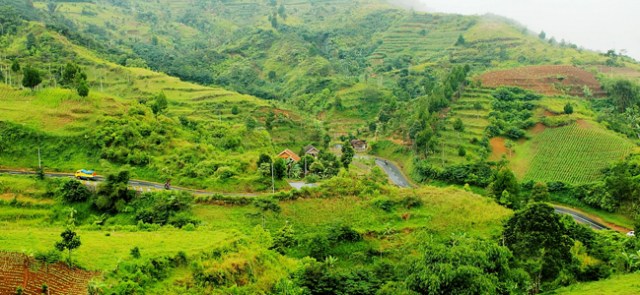
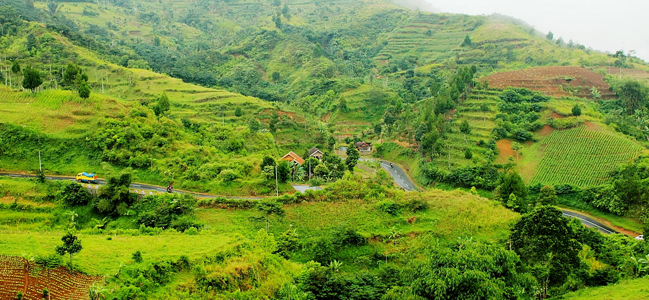
The enchanting land of Sunda stretches from the Sunda Strait in the West to the borders of Central Java in the east. The region is primarily mountainous, with rich green valleys hugging lofty volcanic peaks, many of which surround the capital of the province, Bandung. The history of West Java is a story of trade, spices, and the rise and fall of powerful kingdoms.
West Java, a unique province with so many contrasts in the culture. This is an area where many people would be surprised that this are have a hundreds maybe even thousands beautiful and adorable place which make this region beautiful and unique in their own way.
In the late 1500’s the region was ruled from mighty Cirebon, which still survives as a sultanate today, although a shadow of its former glory. West Java was one of the first contact points in Indonesia for Indian traders and their cultural influences and it was here that the Dutch and British first set foot in the archipelago. The Dutch moved their center of operations to Sunda Kelapa (now Jakarta) after fierce competition and rivalry with the British, only to return at a later date.
This province (West Java) has its own unique culture and language, both called Sundanese which is also used to call its people. The ancient kingdoms of Tarumanegara, Pajajaran, Banten and Cirebon would make interesting studies for the student of archaeology Cirebon is located on the border between West and Central Java, having a mixed culture originating from the ancient Cirebon and Banten kingdoms, resulting in similar customs and dialects of the two people, although Banten is located at the extreme western part of the province.
The road from Jakarta to Bogor, Garut and Bandung passes through a beautiful panorama of mountains, rice fields, traditional villages and small holiday resorts. An expressway connects the lively capital city with Bogor and the mountain areas, and onward to Bandung.
West Java – People and Culture
Renowned for showing uncommon warmth, along with courtesy and politeness. They have a strong sense of helping each other when in need. The word we is quite commonly used in basic conversation, sharing tasks together. Treating each other with consideration, not offending others or making anyone uncomfortable or angry are considered as elementary manners.
Thus, disagreeable or unpleasant facts are not communicated directly. Instead, people will say what they think someone wants to hear rather then what it is actually a flat refusal. Kindness and consideration is also accorded to foreigners, and it is useful to know the custom of the people. For instance, pointing one’s toes at another is considered impolite, particularly when sitting with older people.
Sundanese culture combines very diverse elements. Sundanese language and manners range from highly refined and formalized to downright vulgar and ribald.
Sundanese performing arts comprise a dynamic tradition in which experiment has always been a vital factor. Even the most conservative musicians pride themselves on innovations they have introduced, as well as on preserving intact the tradition they have inherited, without apparent contradiction.
West Java – Arts
Dances – The ancient royal capital of Cirebon holds performances of masked dances, some of which continue traditions from hundreds of years ago. In the city of Subang there is the Bajidoran performance, and all over Sunda you can hear the soft melodious environments of Gamelan Degung and Tari Kreasi Baru (modern dance). The Jaipongan dance is normally associated with the cultural life of Bandung; this dance is very popular in West Java and can even be thought of as one of Indonesia’s national dances, as it is popular everywhere around the archipelago. Created by combining Sundanese classical dances, this dance often involves the entire audience joining in.
Wayang Golek (Puppet Show) – An art form particular to West Java, and one which has survived many generations. Wayang is performed not merely for entertainment but also functions as a method of religious and philosophical teaching. Wayang Golek is performed by a Dalang, acting all at once as narrator, operator and performer. The performance customarily lasts all night long.
Gamelan Degung and Tembang SundaSome of the most classical genres, such as Gamelan Degung and Tembang Sunda are little more than a century old, and have changed fundamentally in the last fifty years. To remain in work, performers must follow artistic fashion.
Batik – Batik cloth is made in a traditional technique of hand decorating, which has been handed down for generations. This age-old method of drying cloth painted in patterns with the aid of molten wax was first introduced by Persians and Egyptians and brought to Indonesia in the 13th century by early traders, then broadened and improved upon by the Javanese. Traditionally batik is designed in subtle shades of blue, brown and white, produced with natural vegetable dyes. A design is drawn on paper, then traced onto the cloth using a cooper funnel (Canting) to transfer the hot wax from a vessel, as it is painted on the fabric through a hollow-pointed instrument. Whether painted or stamped, Batik is one of the most popular Indonesian craft textiles.
West Java – Cuisine
West Java is best known for Sundanese food, which unusually for Indonesia is the places for special emphasis on fresh or even raw ingredients. Sundanese food tends to be simple yet tasty unless you add sambal dadak to your food (sambal dadak: fresh chili sauce and other herbs ingredients grinded together). If you’re looking for more spicy taste, just add this sambal dadak with nasi timbel (steamed rice formed into a roll inside a banana leaf) and other specialty dishes. This mouthwatering treat is too good to be missed! Usually refreshing savoury sour vegetables soup flavour with tamarind (or sayur asam) is accompanied by nasi timbel.
A textural specialty of Sunda (West Java) is karedok, a fresh salad made with long beans, bean sprouts, and cucumber with a spicy peanut sauce. Other main Sundanese dishes include Soto Bogor (from Bogor area), is a refreshing spicy aromatic noodles soup dish from its street food status to its rightful place as the signature dish of West Java and Indonesia, and Pepes ikan (main ingredients is a fish, Indonesian basil, mixed with crushed and blended herbs, folded into a banana leaf, then steamed until they’re ready to eat).
Also Batagor dish (literally means, fried meatballs and fried tofu) is one of the most well-sought specialty, made from blended slices of meatballs, tofu, bean sprout with a special tangy spicy peanut sauce.
Satay or Sate (sliced, seasoned, skewered and grilled meat (chicken, beef, goat) served with soy and delicious peanut sauce), is also a favourite in West Java (Bogor and Bandung).
People with sweet tooth might fancy pisang molen (literally Sundanese Food means, molen banana), Indonesian traditional pastry filled with banana and cheese. For a variation, try brownies kukus (steamed brownies). Es cendol, made of blended/grinded rice, palm sugar, and coconut milk, is delightful on a hot day. While for a colder day, you might want to taste bandrek (sweet ginger drink, served hot) or bajigur (coconut milk flavour drink with palm sugar, served hot).
Hot snacks in West Java are widely sold throughout the city provinces. Among them are pisang goreng (banana fritters), casava goreng, and many more. You might be interested in trying other snacks such as, peuyeum goreng (fermented cassava, fried), nanas goreng (fried pineapple), ketan bakar (roasted sticky rice) and jagung bakar/rebus (roasted/boiled corns) and so on.
West Java – Flora and Fauna
West Java is covered with tropical forests with flora and fauna rarely found in other provinces. Further, its tropical forests are rich with various animals, among them many different types of monkeys. It’s no wonder-the Land of Sunda, principally the Parahyangan Highlands, is a region of West Java that has received copious attention to detail and diversity from the forces of creation long ago (Parahyangan means “Abode of the Gods”).
Whatever you are looking for in your tropical vacation, you will certainly find something to please and surprise you in modern and traditional West Java! Plan on spending time to get around (roads are not always easy to navigate), but prices are fair and the locals friendly.
Here is great places to visit in West Java:
Bogor
Bogor is famous because of its Botanical Garden which borders the Palace Grounds, covering an area of 87 hectares with thousands of species of plant-life from all over the world, including towering age old trees and the rarest kinds of orchids. See the original “Havea Brazilliensis” rubber tree, formerly imported from Brazil, and world’s largest flower, the Rafflesia, a foul smelling and stemless as well as leafless plant.
Visiting Bogor, the whole car trip will be memorable, as scenic tropical beauty all around is really astonishing. You will also pass the beautiful tea plantations, rice fields, traditional village houses and breathtaking mountain views.
Bogor previously known as “Buitenzorg” (Sans soucis or Without worries), during the Dutch colonial era, Bogor actually lies closer to Jakarta (50 km) than it does to Bandung (120 km). Appropriately named by the Dutch as a town “without worries”, they chose Bogor to be the site for constructing the first palace of the Dutch Governor General way back in 1745. Later restored in 1832, the palace still stands solid and elegant today with its stretched out gardens where deer roam freely on the green grass under majestically tall old trees.
Bandung
The capital of West Java is situated on a plateau 768 meters above sea level with a cool climate throughout the year. Several institutes of higher education are located here, including the country’s prestigious Bandung Institute of Technology. There are short drives up to the mountain resorts of Lembang and the Bosscha Observatory, and higher to the volcanic crater of Tangkuban Perahu, the only crater in Java accessible all the way by car as far as its rim. It is an awe-inspiring sight of emanating sulfur fumes.
Bandung has a lot to discover, not only the food of course, but there are lovely places around Bandung where you can enjoy the green sceneries and historical buildings. No beaches around Bandung, unfortunately, but waterfall and mountains would be the amazing alternative.
Banten
This is the coastal area where the Dutch formerly landed to trade. Banten has few relics to show of its past grandeur, however, there are the ruins of powerful Moslem kingdoms such as the palaces of Surosowan and Kaibon, the grand mosque of Mesjid Agung Banten (1599) and a Dutch fortress and an old Chinese temple.
Explore Ujung Kulon – Part of Banten, located on the southwestern tip of West Java, is a wildlife reserve of 51.000 hectares covering the Ujung Kulon peninsula and the nearby islands of Panaitan and Peucang. The reserve is a dense forest and is the home of the last surviving one-horned rhinoceros of which only 50 remain. Ujung Kulon is accessible by boat and the closest departure point is Labuan on the west coast.
Garut
Garut is an Old Dutch hill station and a characteristic Sundanese town in the highlands, surrounded by mountains, volcanoes, and crystal clear lakes.
This cool place can be reached from Bandung in approximately two hours. Due to the scenic beauty of this there are many places of interest for nature lovers. The northern part of the region is reserved for the development of the city of Garut while the southern region is rich with a beautiful coastline, nature preserves and beautiful scenery. Since the time of the Dutch occupation, this region has been developed as a resting place.
See Tasikmalaya – Sixty kilometers from Garut, Tasikmalaya is known for its plaited mats, painted umbrellas and batiks of particular designs and colors.
Visit Naga Village (Kampong Naga), the traditional Sundanese Village – The uniqueness of Naga Village is that in spite of its proximity to modern society, it has retained its traditional customs over the centuries. It is a small village in the beautiful mountains of the Salawu District, some 30 km from Tasikmalaya. Here the most important traditional ceremony is called the “Upacara Pedaran” which illustrates its age-old history and culture, held only once every year.
Pangandaran
Pangandaran is one of West Java’s best kept-secrets as far as international tourists are concerned. Located on a peninsula on the south coast of West Java, about 91 Km from the town of Ciamis, Pangandaran offers uniquely black and white sand, calm waved beaches and spectacular sunsets.
This beautiful peninsula was once better known as a small fishing place; fishermen would set sail in the morning and return in the afternoon with their catch. As the fishermen return, all the locals would meet them on the beach and help them pull the nets heavy with fish to shore. This activity can still be seen today; you can also participate and experience the sensation of pulling the heavy fish nets back to shore and get to know what it is like to be a fisherman. It also makes a swell picture.
Pangandaran is especially of interest to nature lovers, as there is a wildlife reserve in the vicinity where wild birds and other indigenous animals live about freely to be enjoyed by visitors. A forest Conservation Park is located right here, which is another place of special interest to nature lovers.
Explore River Forest Green Canyon – Originallya called “Cukang Taneuh”- the local Sundanese meaning for Soil Bridge- Green Canyon has a 3 meter wide bridge made up of soil above the twin cliffs on both river banks. This natural wonder is surely a spectacular scene that you will not find anywhere else.




 TrulyTravelIndonesia.Com