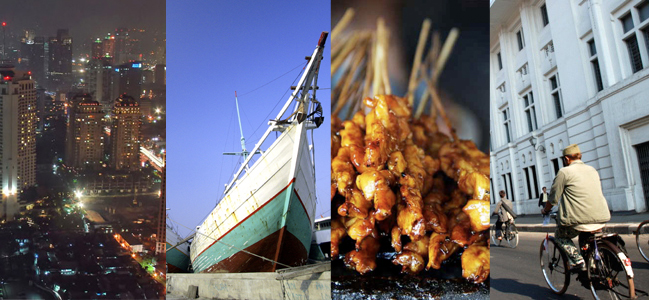
Jakarta is a city of contrasts; the traditional and the modern, the sacral and the worldly, often stand side by side in this bustling metropolis. Even its population, gathered from all those diverse ethnic and cultural groups which compose Indonesia, are constantly juxtaposed as an ever-present reminder of the national motto; Unity in Diversity.
Jakarta, the capital city of the Republic of Indonesia, is a special territory enjoying the status of a province, consisting of Greater Jakarta, covering an area of 637.44 square km. Located on the northern coast of West Java, it is the center of government, commerce and industry and as such has an extensive communications network with the rest of the country and the outside world.
Jakarta itself is built on a wide flat delta, intersected by no less than 13 rivers. Fronting the city in the Bay of Jakarta are a large number of tiny islands, known as the Thousand Islands or Pulau Seribu, a tourist resort for snorkeling and swimming. To its south are the majestic volcanoes of Gede and Pangrango, where are cool mountain resorts like Bogor, Puncak, Sukabumi and Bandung.
Finding its origin in the small early 16th century harbor town of Sunda Kelapa, Jakarta’s founding is thought to have taken place on June 22, 1527, when it was re-named Jayakarta, meaning Glorious Victory by the conquering Prince Fatahillah from neighboring Cirebon.
Jakarta is not only the seat of the national government and the provincial government, this city is also Indonesia’s political center. Moreover, Jakarta is also the center and hub of Indonesia’s national finance and trade. It is no wonder, therefore that you will find Jakarta an ever dynamic city, a city that never sleeps.
Jakarta – History
As the other cities across the world, present day Jakarta is the result many big battles. And like other great cities, Jakarta has also known by many name in its time. When the city served as a portal town for the Hindu Kingdom of Sunda, it was known as Sunda Kelapa, until Fatahillah, the muslim leader of the Sultanate of Demak from Central Java, conquered the city and changed its name to Jayakarta (which mean “Great Deed” or “Complete Victory”). The next ruler of what was then only the seed of present-day Jakarta was the legendary Dutch VOC (Vereenigde Oost-Indische Compagnie or United East India Company in English) who changed the city’s name once again to Batavia; at the time, the Dutch believed that their ancestors were Germanic tribe called Batavi, and they made the city into formidable port fortress.
The name Batavia lasted for over 300 years, during which time the early cultures and societies of Jakarta were shaped. In 1800, the VOC went bankrupt and its territories were claimed by the Dutch kingdom and become a colony called the Dutch East Indies. Batavia become the official capital and this marked the beginning of a golden era for the city. The name of Jakarta was first adopted in 1942 when the Japanese took over the city from the Dutch, and the capital of Indonesia has been known by the same name ever since, even after the country proclaimed its independence in 1945. Most of the buildings that can be seen standing proudly all over the city, like the iconic Monas (The National Museum) were built after the Dutch had already given up their fight for the country back in December of 1949.
Jakarta – People and Culture
The ethnic Jakartan called “Orang Betawi” speaks Betawi Malay, spoken as well in the surrounding towns such as Bekasi and Tangerang. This language has two variations: the conventional Betawi Malay and the modern Jakarta Malay. While the first is spoken by the elder people, born and bred in Jakarta, the second is spoken by the younger generation and migrants.
Jakarta – Administrative Divisions of Jakarta
Jakarta is administratively equal to a province with special status as the capital of Indonesia. It has a governor (instead of a mayor). As a province, the official name of Jakarta is Daerah Khusus Ibukota Jakarta (“Special Capital City District of Jakarta”), which in Indonesian is abbreviated to DKI Jakarta.
The cities/municipalities of Jakarta are:
– Central Jakarta, is Jakarta’s smallest city and home to most of Jakarta’s administrative and political centre. It is characterized by large parks and Dutch colonial buildings.
– West Jakarta, has the highest concentration of small-scale industries in Jakarta. The area includes Jakarta’s Chinatown and Dutch colonial landmarks. West Jakarta contains part of Jakarta Old Town. – South Jakarta, originally planned as a satellite city, is now the location of large upscale shopping centres and affluent residential areas. Jakarta Selatan functions as Jakarta’s ground water buffer, but recently the green belt areas are threatened by new developments. Much of the CBD area of Jakarta is concentrated in Setia Budi, South Jakarta, bordering the Tanah Abang/Sudirman area of Central Jakarta. – East Jakarta, territory is characterized by several industrial sectors erected in this city. Also located in East Jakarta is Halim Perdanakusuma International Airport. – North Jakarta, is the only city in Jakarta that is bounded by the sea (Java Sea). It is the location of the Tanjung Priok Port. Large-scale and medium-scale industries are concentrated in North Jakarta. North Jakarta contains part of Jakarta Old Town, formerly known as Batavia since the 17th century, and was a centre of VOC trade activity in Dutch East Indies.
The only regency of Jakarta is:
Thousand Islands (Kepulauan Seribu), formerly a district within the city of North Jakarta, is a collection of 105 small islands located on the Java Sea. It has a high conservation value because of its unique and special ecosystems. Marine tourism, such as diving, water bicycle, and wind surfing, is the most important touristic activity in this territory. The main transportation between these islands are speed boat or small ferries.
Jakarta – Local Cuisines
Jakarta has a vast range of food available at hundreds of eating complexes located all over the huge city. The Jakarta street food remains vibrant and a lot fun, Jakarta fine dining scene is now liberally studded with a huge variety of restaurants, from those which can boast uncanny ability to fuse different cooking methods and food philosophies into an appetising whole. In addition to selections from all over the country, you can also find excellent Chinese, Japanese, and many other international foods thanks to the cosmopolitan population.
Jakarta Street Food, Jakarta is famous for its street delicacies. Every Region of Jakarta has its own unique offering of street foods. Some areas for looking for great /exceptional and unique. You can find Jakartan versions of many dishes, often tagged with the label betawi (Indonesian for “Batavian”).
Here are samples of Betawi cuisine and Jakarta Street Food:
– Sop iga sapi, beef spare rib soup that takes a simple Dutch dish and piles on Indonesian spices. – Soto betawi, coconut milk broth with beef tendons, intestines, tripe.
– Kerak telor, omelette from egg cooked with glutinous rice and served with shredded coconut and a dried shrimp topping. – Gado-gado, rice roll, steamed vegs (bean sprout, green beans, cabbage), fried tofu, boiled egg, rice crackers in delicious peanut sauce. – Ketoprak, rice roll, tofu, bean sprout, crackers in peanut sauce.
– Bubur Ayam, Savoury Pouridge with curry sauce, fried soy beans, chicken slices, rice crackers, soy sauce and sambal. – Nasi uduk, rice cooked in coconut milk similar to nasi lemak, served with choices of various toppings; such as fried chicken, beef, fried shalots sambal (chilli sauce). – Nasi ulam, rice cooked in coconut milk served with fried minced beef, sweet fried tempe, many other toppings, cucumber, and sambal (chilli sauce). – Satay/Sate, grilled chicken or beef on skewer served with aromatic peanut sauce and sweet soy sauce.


 TrulyTravelIndonesia.Com