
Overview
East Java might be the least populated area in Java island, but its charm and unique terrain will captivate its visitors. Capital of East Java province, Surabaya, is a cosmopolitan city and you can find any comfortable surroundings and facilities there.
However within a short trip you might be tempted to enjoy the natural charms such as climbing Mt. Bromo and enjoying fabulous sunrise there or probably trying to conquer Mount Semeru, the highest mountain in Java (about 3676 meters above sea level). Some parks are available for those who prefer natural surroundings. An island on the eastern part of Java called Madura is also famous for its distinct culture and bull races of karapan sapi, usually held in August and September every year.
East Java – History
In 1292 the Majapahit dynasty, based in and around East Java, began an empire that was to dominate the entire archipelago, the Malay peninsula and part of the Philippines. Majapahit also established profitable trade relations with China and other countries of the South East Asian region. This was the beginning of profitable trade relations with China, Cambodia, Siam, Burma and Vietnam. As the power in Central Java declined in the 10th century, powerful kingdoms rose in East Java to fill the power vacuum.
During the reign of King Erlangga, both East Java and Bali enjoyed lucrative trade with the surrounding islands, and an artistic and intellectual renaissance. Part of the Mahabarata epic were translated and re-interpreted to conform to an East Javanese philosophy and view of life, and it was from this area that East Java inherited most of its temple art. Today the open-air amphi theater at Pandaan tells some of the stories of this glorious past. Aided by the Java Ballet performances against a backdrop of distant volcanoes, any traveler will be easily enthralled by the East Java experience, capturing the spirit of the province’s culture and scenery. Its capital, Surabaya is second to Jakarta in size, population and commerce. East Java is also the most industrialized province in the nation. Its economy is based on agriculture, fishery, oil industries, coffee, mangoes and apples.
East Java – People and Culture
East Javanese are known for their outspoken manner and loud voice. They are the type who would talk to strangers and help them if need be. They tend to be frank and enjoy a good conversation.
East Java – Arts
Ludruk – is the art of traditional drama of East Java. Traditional drama that was exhibited by a group that in performing arts on stage by taking the story of people’s daily life, stories of struggle and others are interspersed with jokes and accompanied by the gamelan as a musical.
Remo Dance – comes from Jombang, East Java. This dance is a dance that was originally used as an introductory event ludruk. However, the development of this dance often danced separately as a welcome to guests of the state, the ceremony, as well as in local arts festival. This dance is actually a prince tells of the struggle on the battlefield.
Mask Dance – The art of Mask Dance from Malang, East Java, is the result of a combination of cultures of Central Java, West Java and East Java (Balambangan and Osing). So that the roots of the dance movement contains elements dynamic wealth and ethnic music from Java, Madura and Bali. Nevertheless, the mask dance it is estimated that only appear in the early 20 ‘s and flourished during the war for independence. This dance is a metaphor for human nature, so many models that describe the situation of the mask and different conditions, such as: cry, laugh, sad, confused, and so on.
Wayang kulit – is the traditional art of Indonesia, which takes place mainly in Java. Puppetry comes from the word Ma Hyang half towards the Almighty. Shadow theatre played by a puppeteer who is also characters in the Narrator dialog puppets, with music gamelan played by a group of nayaga and the song sung by the singer. Puppeteer behind puppet theater screen, the screen is made of white cloth, while the electric lights shining behind him or lamp oil (blencong), so that viewers who were on the other side of the screen can see the puppet’s shadow that falls on the screen. In
Karapan Sapi – One of attraction icon of Madura culture is Kerapan Sapi (Bull Race). The bull attraction is said come from Sepudi Island, Sumenep regency. The founder of this bull racing is Prince Katandur at 13 century and round into hereditary tradition up to now. The frequent bull that competeted is minimum have been age 2 years with body height 120 cm.
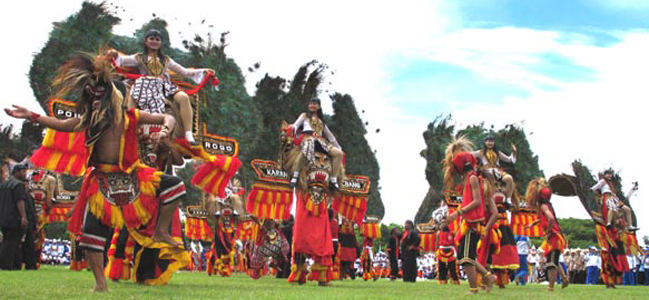
Reog Ponorogo – Reog is one of the artistic culture that comes from Ponorogo, Java East. The city and this it is the real origin of Reog. Ponorogo city gate was decorated by the Warok figure and gemblak, two figures involved appear in shown Reog. Reog is an art that is still very thick with mysticism things mystical and powerful. Movements in the dance, Reog Ponorogo describe the facts of the man in the way of life began was born, lived, until his death. His philosophy is very deep.
East Java – Cuisine


 TrulyTravelIndonesia.Com