> Central Java
Overview
Central Java, the heart of the island of Java, where the old Javanese traditions and the centre of arts still remain strong. History has left its footprints across Central Java, an area rich in culture and tradition descending from a powerful Hindu and Buddhist past, and more recent Islamic influences. Due to its colorful past, Central Java has become the place it is today–a beautiful area full of modern amenities yet still retaining its tranquility and peace.
Flanked by West and East Java, this province is centrally located on Java island with Semarang as its provincial capital situated on the northern coast. A network of good roads and highways in addition to solid railways linking its major cities and villages plus the accessibility to reach it by air through three main airports, all assure the visitor that he finds himself in a region with more than adequate communications.
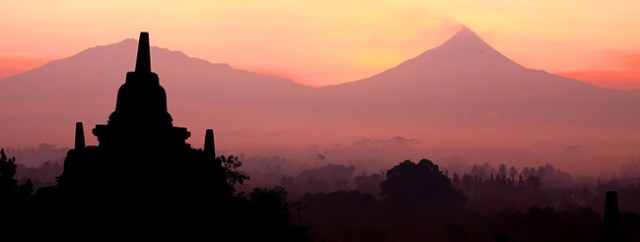
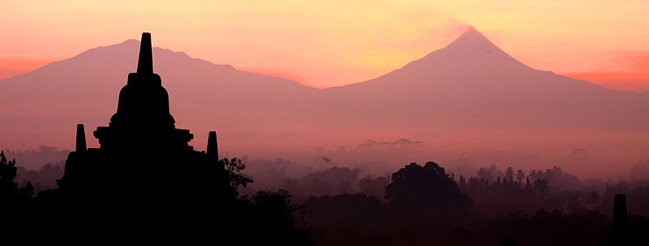
It’s here where you can find the magnetism of Borobudur temple, the biggest Buddha temple in the world and the excellent Prambanan temple. Also the place where you can find the ancient shrines of Dieng Plateau, the place of the mysterious temple. The most forgotten place in this province. But don’t under estimated this unpopular place, it’s has truly magnificent view.
Central Java – History
Under the Syailendra and old Mataram Kings in the 8th and 10th centuries the early Javanese culture flourished, and it was during this period that Borobudur temple was built. On the 10th century, Majapahit kingdom based in East Java began to gain dominance. After the fall of Majapahit, Demak in 15th century, and Islamic based kingdom, started to rise.
After Demak Kingdom fell, Pajang Kingdom led by Djoko Tingkir or Sultan Adiwijaya was established. And when Pajang finally fell down, Sutowijoyo that received land as a gift from Sultan Adiwijaya established the Islamic Mataram Kingdom.
In the middle of the 16th century, Portuguese and Spain arrived Indonesia to seek for spices that would be traded in Europe. At the same time England and later Netherland also arrived in Indonesia. The Dutch’s intention changed into exploiting Indonesian natural resources by employing Indonesian people, including Central Java residents and did anything that hey wanted in every aspects of life.
In the early 18th century, there was a dispute between Mataram Kingdom family in appointing the new king. As the intervention of the Dutch, the dispute was solved by Gianti Treaty in 1755. Mataram were divided into two parts. They are Surakarta Hadiningrat or Kasunanan Palace (Including Central Java area) and Ngayogyakarta or Kasultanan Place in Yogyakarta.
Central Java – People and Culture
Central Java is considered to be the heart of the Javanese culture. Home of the Javanese courts, Central Javanese culture formed what non-Javanese see as the “Javanese Culture” along with it stereotypes. The ideal conducts and morals of the courts (such as politeness, nobility and grace) influence the people tremendously. The people of Central Java are known as soft-spoken, very polite, extremely class-conscious, apathetic, down-to-earth, et cetera. These stereotypes formed what most non-Javanese see as “Javanese Culture”, when in fact not all of the Javanese people behave that way. Moreover, most Javanese are far from the court culture.
Central Java – Arts
Dance – You can even see the court influences in the art forms. The dances of the courts of Java are usually slow and graceful, with no excessive gestures. The people followed this approach, and as a result, slow-paced and graceful movements can even be found in folk dances throughout Central Java (with some exceptions). You can enjoy the beauty of Central Javanese dances in “Kamajaya-Kamaratih” or “Karonsih”, usually performed in a traditional Javanese wedding.
Batik – Central Java is famous and well known for its exquisite batik, a generic wax-resist dyeing technique used on textiles. There are different styles of batik motifs. A centre of batik production is Pekalongan. Other centres are Surakarta and Yogyakarta. Batik in Pekalongan style which represent gaya pesisir (or coastal style) is different from the one in Surakarta and Yogyakarta, which represent batik from the heartland of Java (gaya kejawèn)
Music – Central Javanese music is almost synonymous with gamelan. This is a musical ensemble typically featuring a variety of instruments such as metallophones, xylophones, drums, and gongs; bamboo flutes, bowed and plucked strings, and vocalists may also be included. The term refers more to the set of instruments than the players of those instruments. A gamelan as a set of instruments is a distinct entity, built and tuned to stay together — instruments from different gamelan are not interchangeable. However, gamelan is not typically Central Javanese as it is also known somewhere else.
Central Java – Cuisine
The food in Central Java is influenced by the two ancient kingdoms of Yogyakarta and Surakarta (also commonly known as Solo). Many of Central Java-specific dishes contain the names of the area where the food first became popular. For example:
• Gudeg, Young jackfruit, chicken and hardboiled egg stew, this dish has a unique sweet and savoury taste. This is usually accompanied by a side dish of spicy beef inner skin & tofu stew.
• Bakso Solo, Bakso literally means meatballs, made of beef, and served in boiling hot soup with mung bean-thread noodles, green vegetables, shredded cabbage, and various sauces (chili, tomato). This version from Solo has super-sized meatballs, the size of tennis balls. Also known as Bakso Tenis. Bakso is a Chinese-influenced dish, but has become a popular snack throughout Indonesia.
• Ayam goreng Kalasan/Klaten, Chicken, stewed in spices (coriander, garlic, candlenut, and coconut water feature strongly) then deep-fried until crispy. Served with sambal and raw vegetable salad.
• Timlo Solo, A beef and vegetable soup.
• Soto Kudus, Soto is a common Indonesian soup infused with turmeric, and can be made with chicken, beef, or mutton. The version from Kudus, a Central Javanese town, is made of chicken.
• Jenang Kudus, A sweetmeat made from rice flour, palm sugar and coconut milk.
• Lumpia Semarang, Fried or steamed spring rolls. The filling varies, but consists mainly of meat and bamboo shoots. It is served with sweet fermented soybean sauce (tauco) or sweet garlic sauce. Another accompaniment is acar/Indonesian style sweet and sour cucumber pickle and chili.
• Surabi Solo, A pancake made of coconut milk, mixed with a little rice flour as thickener. Srabi can be served plain, or with toppings such as sliced banana, chopped jackfruit, chocolate sprinkle (muisjes), or cheese.
• Nasi Bogana Tegal, A steamed rice dish wrapped in Banana leaves and served with a variety of side dishes.
• Teh poci Tegal, Tea brewed in a clay teapot, served with rock sugar. Tegal, a Central Java town, is a major producer of high-quality tea.





 TrulyTravelIndonesia.Com